Reading List: Q2 2026

I make these lists public to try to build readership across multiple dimensions: For this newsletter, for the authors whose work I love, and for the sources from which I discover new avenues. Keeping with the “1,000 True Fans” theme, anything I can do to help deserving creators receive more exposure and small bumps in sales volumes is worth transcribing some notes.
As an Amazon Associate I earn from qualifying purchases. If you click through on a book link and buy something, I get a small commission.
“Creating Space” is a combination of free book, music and arts reviews, subscriber only technology and strategy insights and some paid-subscriber only content. Please consider becoming a subscriber, paid or free, so help build this community. Your comments, feedback and notes are much appreciated.
“Girl to City,” Amy Rigby, music/biography, finished April 13.
Recommended based on some 1980s punk biographies
Leader of the folk-rock trio “The Shams,” Riggs takes a tour through the bohemian (literally) life in the Lower East Side of the mid-80s and -90s, with detours to Boston’s clubs like the Rat and TT The Bears. There are cameos from bands that I recognize. This isn’t a drugs-and-drinking book; it’s more of clunky van rides and bands that start and re-aggregate like magnets tossed into a tray of ball bearings. I’ll be reading the sequel shortly.“For A Limited Time Only,” Peng Shepherd, sci-fi, finished April 15.
Part of the Amazon.com “Time Traveler’s Passport” series
A great way to discover a new author via a short story in a collection that I’m reading by “borrowing” the books serially. Inverting the usual “I’d go back and change history” trope, Shepherd’s story makes you focus on what you’d do more of now if you knew the (sad) future.“Constituent Service,” John Scalzi, sci-fi, finished April 21.
Picking up some short stories/novellas from one of my starred authors
A novella (86 page) length story that is right down the barrel of the Scalzi canon: quirky aliens, a lovable heroine who doesn’t fit the swashbuckling stereotypes, and an inter-species crisis amplified (literally) by large creatures stomping for joy. Scalzi has a way of making even the most mundane things - dog poop, in this case - heart-warming and interesting enough to make me forget I’m doing most of my reading on a permanently delayed NJ transit train. And then he uses those same vehicles for binding love across as many biological, time or space dimensions as required.“Death of The Author,” Nnedi Okorafor, sci-fi, finished May 1.
Award nominee, and so well deserved.
I love finding new authors who push the edges of sci-fi away from space opera and alien politics into exploring what humanity might — or might not — become, and our reflection in and of our technologies. Okorafor crafts a beautiful story that resolves in the last few pages, interweaving Nigerian life and history, the life of the instantly famous author, a story-within-a-story and the roles of community, family, and traditions in maintaining our very long term stories.“The Cartographers,” Peng Shepherd, sci-fi/fantasy, finished May 9.
Following up on “Time Traveler’s Diary” short story.
I have loved maps since discovering AAA road atlases and promotional vacation spot maps as a tween. Shepherd crafts a story that is part detective novel, part love story, and an homage to maps and their curation. It unfolds, most gently, sometimes with sudden tears and rips, so you can see the entirety of the landscape before and behind you. I alternating reading with listening to Thank You Scientist’s “Maps of Non-Existent Places” because that’s the premise of the book and touches on that feeling of longing for something beyond the visible edge.“London Falling,” Patrick Radden Keefe, non-fiction, finished May 14.
Having visited I’m now on a London and Paris kick.
I really and truly wanted to love this book — my first non-fiction account of life in modern London, a backstory about old school Jewish families and the post-Big Bang (relaxation of banking laws) fintech explosion that mirrored my tech days at Sun Microsystems, and a search for truth about a teen’s death. What emerged, however, was a collage of backstories, sidetracks and soft-center theories that made it somewhat unclear for whom and why Keefe was writing: To demonize the influence of Russian money in the London economy? To reveal he had stumbled onto a police informant and found the business tawdry? To give appropriate memory and respect to Zac Bettler, the young man around whose death the story revolves, and his family’s search for answers that would let them move from grief to memory? This has been a NY Times bestseller, perhaps because of the progressively salacious disclosures, but it has the pacing of a documentary.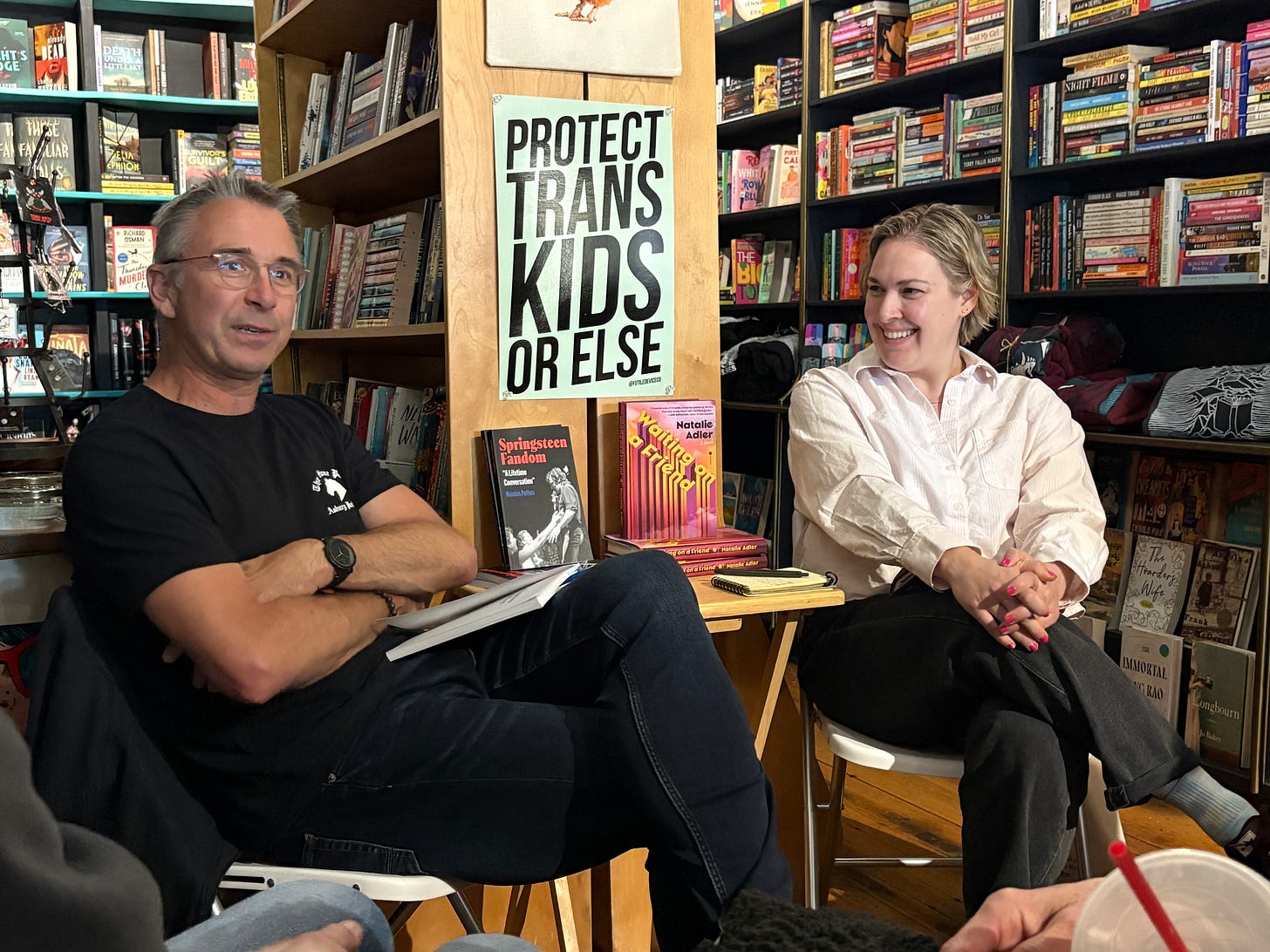
Authors Nico Pethes and Natalie Adler in conversation about their wonderful books, at Wolfe and Kron Books in Asbury Park, June 1. “Waiting On A Friend,” Natalie Adler, fiction, finished June 4.
Introduced at a book talk at Wolfe & Kron in Asbury Park; Oprah Daily’s top summer reading pick.
Debut novel from (future) superstar writer Natalie Adler, mid-NJ-famous for her piece claiming Bruce Springsteen’s music for the “others” who hide in the interstitial spaces of his songs. “Waiting On A Friend,” a nod to the Stones song, (and coincidentally released within a day of Sonny Rollins’s death) follows a young woman through 1984’s Lower East Side as her friends die of AIDS. They come back to her as ghosts - gaps in the light, in space, in her visual reference - in a beautiful, longing, loving way, not Ghostbusters-like menaces (Ghostbusters was also released in 1984). Her best friend, whose death is chronicled in the first paragraph, is whom she awaits, and the story deals with love, loss, punk music, counter culture, and listening to the echoes of a place and a time. “Angels in America” and “Rent” progressed our mainstream gross, visceral understanding of the AIDS epidemic; “Waiting On A Friend” will make this accessible to the next generations. Easily one of my favorite books of the year.“Inside The Box,” David Epstein, non-fiction, finished June 5 (but read layered with Adler’s book)
From Epstein’s Substack, highly recommended.
Epstein’s book “Range” has become required reading for my work friends and team members; I eagerly awaited my pre-order of “Inside the Box” because innovation within constraint has been a constant theme in everything from driving small research teams to thinking about Phish jams (in my Phish Studies 2.0 conference poster). Constraints force creativity into play, citing Keith Jarrett’s Köln concerts only played in the middle octaves of a damaged piano as a prime example but chock full of other immediately applicable guidance in decision making and using constraints to remove dimensions.“Springsteen Fandom: A Lifetime Conversation,” Nicolas Pethes, music, finished June 10.
Picked up at author talk with Natalie Adler about “Waiting On A Friend”
My good friend Bill, who was co-conspirator in college radio, and friend and explorer of progressive rock and jazz for more than 40 years, used to say that the best DJs were the one who made you feel like you were sitting in their room, hearing them play records and talk about music one-on-one. Pat St. John in New York, the late and wonderful Pierre Robert in Philadelphia, Mark Parenteau in Boston - when you were listening, you were the only one on the receiving end of the broadcast. Pethes — a professor of culture at University of Cologne — expands that musical interplay to an exploration of Springsteen fandom. He takes us from one-sided adulation and broadcast to interaction, active participation and evolution. Whether it’s the everyman aspects of his music, the marathon concerts that take on revival reverence, or Springsteen’s openness about his mental health and his sincere, deep memory of former bandmates, Pethes takes an academic, cultural and personal approach to Springsteen. It is rooted in the notion that it is a life-long, lifetime conversation, and therefore fandom ages and evolves over that timeline — rather than the aging fan who wishes for “the way it was.” Pethes constructs a series of frameworks - the use of tradition, stories, live performance, and acknowledging the ghosts of history (hence the wonderful parallel to Adler’s book) - in which it’s easy to build our your own sense of what it has been, and will be, in stand in the light of day emanating from The Boss.“Going Deep,” David Neale, fiction, finished June 12.
Seen in the Princeton alumni magazine.
Continuing the college radio references, David Neale was also a college radio peer. After a career in law, his retirement portfolio included his first novel, a perfect albeit sometimes upsetting beach read. There are faint echoes of “write what (or who) you know” coupled with deep dissection of toxic parenting and 1970s attitudes that are just coming to the surface after a luxury car’s worth of therapy. Revolving around his father’s definition of “mensch” (classically a good, caring person, but here your mileage varies) and protagonist Jonah’s sense of success, self-worth, and vulnerability, there are some plot points you can see coming, and others that thoroughly come up from the deep.“Mathey Girls,” Melody Chu, fiction, finished June 14.
Another Princeton alumni magazine prompt.
Fresh on the heels of Princeton Reunions and picking up some orange-and-black themed books, I bought Chu’s quasi-memoire of life before a 20th Reunion to look for congruence with my own experiences. In her adaption of her first-year college dorm enclave turning into lifelong friendships, intercepted by the death of their group’s center, there are some parallels to what I experienced at Princeton: feeling the “other,” balancing the dynamic range of opportunities with the veiled elitism with finding my own tribe. The book is equally about strong cultural family structures and how they accommodate (or don’t) grief, loss and adversity. In stark contrast to “Going Deep” (also Princeton tinged) where the protagonist actually is an imposter and hasn’t come to grips with it; the central Mathey character exudes every bit of imposter syndrome before being forced into actual adulthood on the south side of 40.“The Radiant Star,” Ann Leckie, sci-fi, finished June 22.
Follower and consumer of all of her work.
Tying together the space opera of the “Ancillary Justice” trilogy with a literal hagiography of saints who seek guidance from a non-existent star on a rogue planet, the story is full of palace intrigue, political side plots and fundamental questions of faith (and science). Leckie uses gender and pronouns to create power, elevation, status, and life goals — reading her work will make you see gender as social rather than biological. There were themes that felt more final to the Imperial Radch rather than convey the history and future of this strange rogue planet and its people, but perhaps that was the point — four religions colliding over governance, famine and a distinct lack of divine presence.
“This isn’t a drugs-and-drinking book; it’s more of clunky van rides and bands that start and re-aggregate like magnets tossed into a tray of ball bearings.” - good one.
A question if I may, will you be posting about your visit to the camps? If not, I get it. If you do, I very much would like to read it.